
Pinjarup, Balardung, Wiilaman, Kaniyang, Wardandi, Bibbulmun, Minang, Goreng Country
It is early 2021 and Australia in common with the global community, was in the middle of the coronavirus pandemic, with the West Australian state border closed to the outside world. Disappointed like many with cancelled travel plans, I elected to use the pandemic period constructively.
On bush trips I continually encounter those most Australian of plants the Banksias. Banksias are a plant genus almost entirely endemic to Australia.
There are 79 species (and counting,) of which an impressive 61 species are found in Southwestern Australia. The various species flower year round with the nectar, and insects attracted to that nectar, an important source of nutrition for native wildlife.
There is an excellent Book titled Banksias (second edition) written by Kevin Collins, Kathy Collins and Alex George that acts as a fantastic guide for Banksia enthusiasts.
What began as a small local project to view some local Banksias, ultimately grew to span almost four years and the length and breadth of the Southwest.
Continued from Part 1 (semi-arid adapted Banksias of WA)
https://quollingaround.com/2024/05/23/the-semi-arid-adapted-banksias-of-inland-wa/
Many of the species found in Australia’s true Southwest can be seen in adjoining regions and so accordingly these are covered in later posts.
When the Europeans arrived in what is now Western Australia they imposed the four familiar seasons from the old world on this new land, unaware that the indigenous Noongar tribes of the Southwest already used a six season yearly cycle. These seasons are fluid, that is not depandant on dates, but are represented by changes in the natural world.
In this the second of a four part series, I have listed the local Banksia species by their flowering period according to the six seasons of the Noongar Calendar.
Birak (December/January) – Dry and hot – the season of the young
Bunuru (February/March) – Hottest part of the year – the season of adolescence
Djeran (April/May) – Cooler weather begins – the season of adulthood
Makuru (June/July) – Coldest and wettest months – the fertility season
Djilba (August/September) – Mixture of wet days and pleasant warmer days – the season of conception
Kamabarang (October/November) – Longer dry periods – the season of birth
Banksia occidentalis – The Western Swamp Banksia
Flowering Period – Birak and Bunuru
This attractive Banksia is a species restricted to the South Coast of Western Australia from Augusta in the East to Cape Arid in the West, although the distribution is patchy on account of it’s love of swamp margins. The wetlands of Scott River National Park near Augusta provides perfect habitat for this Banksia that flowers from January to March.
The delicate leaves of this species are a delight, and the flowers hidden with the foliage are a delicious rich, ruby red. Each Banksia contains large numbers of flowering spikes.
Banksia occidentalis.

Banksia verticillata – The Granite Banksia
Flowering Period – Birak and Bunuru
A rare range-restricted coastal species of the South of the state between Albany and Cheynes Beach. It is a lover of the soil surrounding granite outcrops, of which there are many on the South Coast. The Bald Head Walk in Torndirrup National Park near Albany and the Mermaid Head 4WD Loop Trail are good for this species during the Summer months.
In addition to the granite habit of Banksia verticillata, the leaves also distinguish it from the other yellow-flowering Banksias, since unlike most other Banksias these leaf margins are entire and are without lobes. These leaves arranged in spirals provide the genesis of the latin name verticillatus (whorled.)
Banksia verticillata.
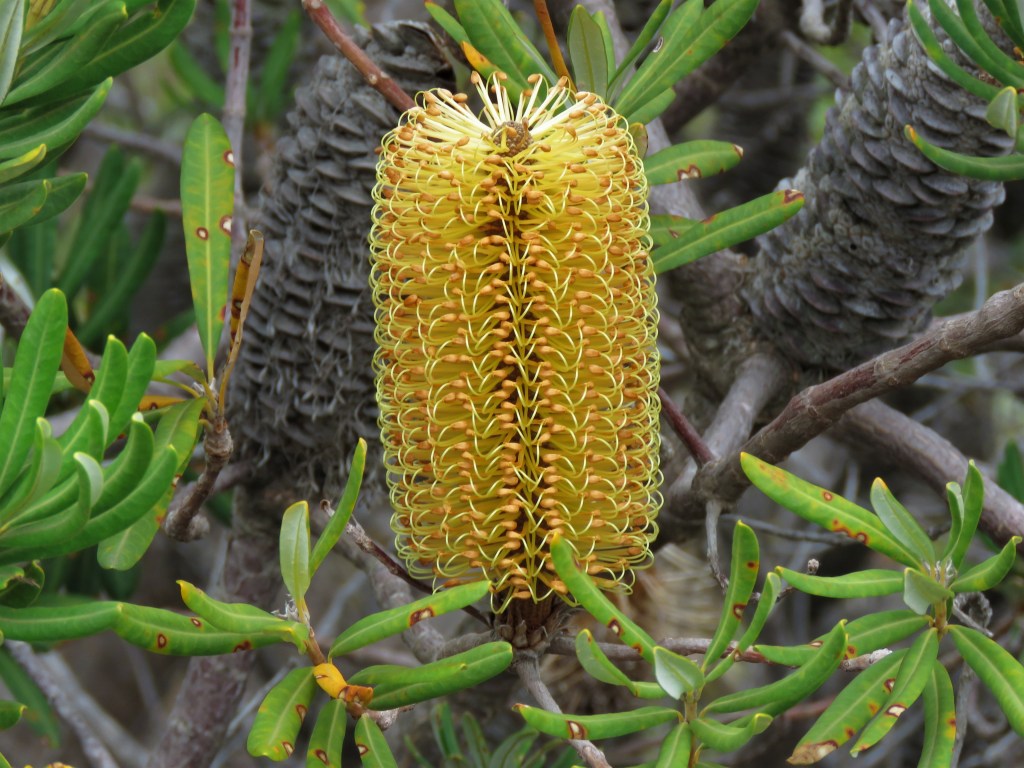
Banksia seminuda – The River Banksia
Flowering Period – Djeran and Makuru
Truly a species of only the Southwest, found from Dwellingup to Two Peoples Bay. It is located alongside the creeks and rivers of the region. Walkers on the Bibbulmun Track pass magnificent stands of this Banksia in the Karri-Marri forests between Donnelly River and Pemberton. Here the understory rings loud with the joyful metallic warblings of the endemic Western Wattlebird feeding on the Banksia blooms.
Banksia seminuda is the tallest Banksia occurring as a tree to 30m in the rich red loamy soils of the Southwest. Arboreal species benefit from this tree, indeed I have thermal imaged a Brush-tailed Phascogale enthusiastically feeding on the flowers in the Jarrah Forest around Collie.
The flowers are usually entirely yellow but the attractive and rarer form pictured below on the Bibbulmun Track has yellow perianths contrasting with magnificent red pistils.
Banksia seminuda.
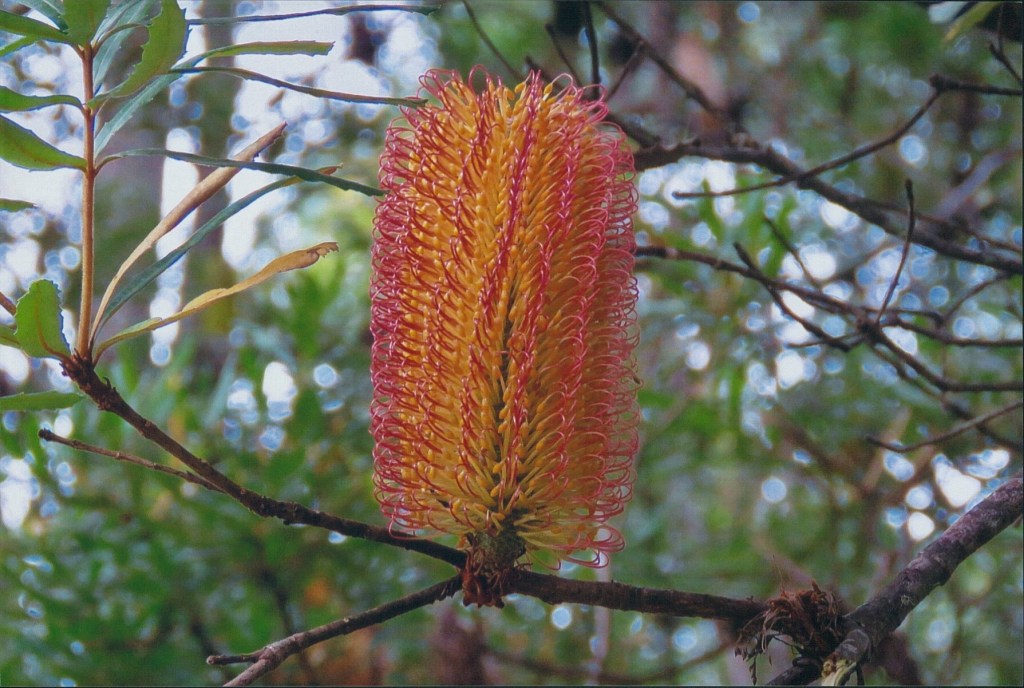
Banksia quercifolia – The Oak-leaved Banksia
Flowering Period – Djeran and Makuru
The flowering period of this Banksia mirrors exactly that of Banksia seminuda, but with a much reduced range, being found only from Windy Harbour to Cheynes Beach. The plant below was photographed in beautiful, rich bush North of the town of Walpole in Mount Frankland National Park.
In common with other native species in the area it likes the peaty marshy ground found in abundance in its range. It is very similar in appearance to Banksia oreophila found further to the East at the Stirling Ranges and Fitzgerald River National Park. The colour of the rigid flowers morphs from a rusty brown above to a rich cream beneath.
Banksia quercifolia.
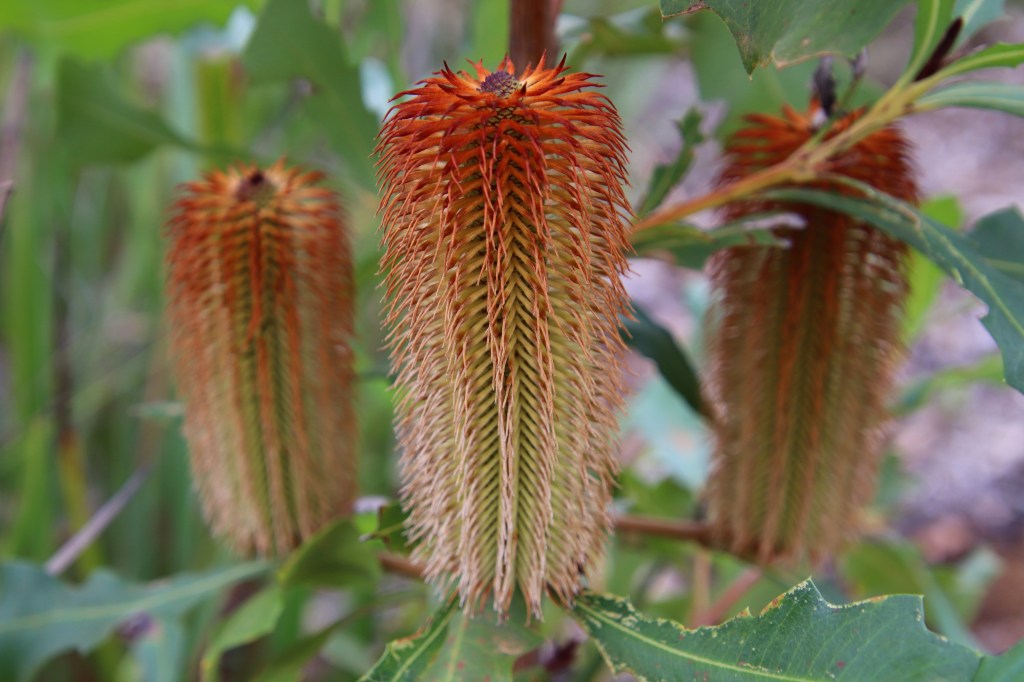
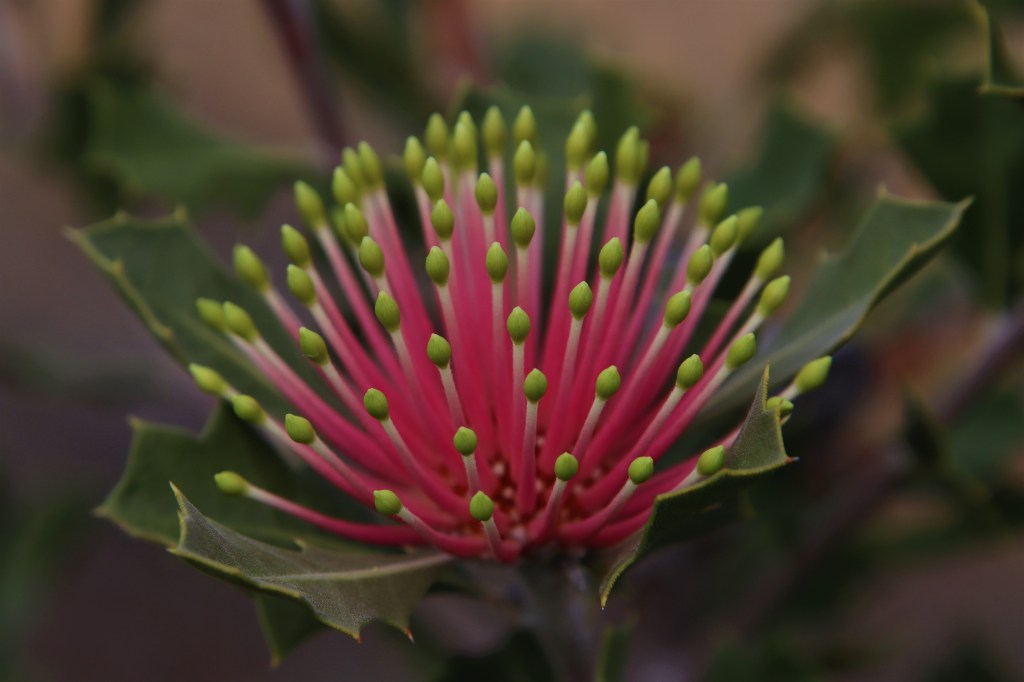
Banksia meisneri (subsp meisneri.) – Meisner’s Banksia
Flowering Period – Djeran, Makuru into Djilba
A shrubby banksia that can hard to find on account of the much reduced habitat in Western Australia’s Wheatbelt Region.
The best part of a weekend was spent searching remaining bushland reserves South of the coal mining town of Collie, before the small, beautifully coloured, pendant flowers were finally sighted at Haddleton Nature Reserve. Situated along a rough 4WD track in deep white sand near a stand of Banksia littoralis, Banksia meisneri the smallest leaves of all the Banksias.
A second subspecies of Banksia meisneri occurs in the Augusta Region, both subspecies being similar in appearance to Banksia pulchella found on the South Coast of WA.
Banksia meisneri.
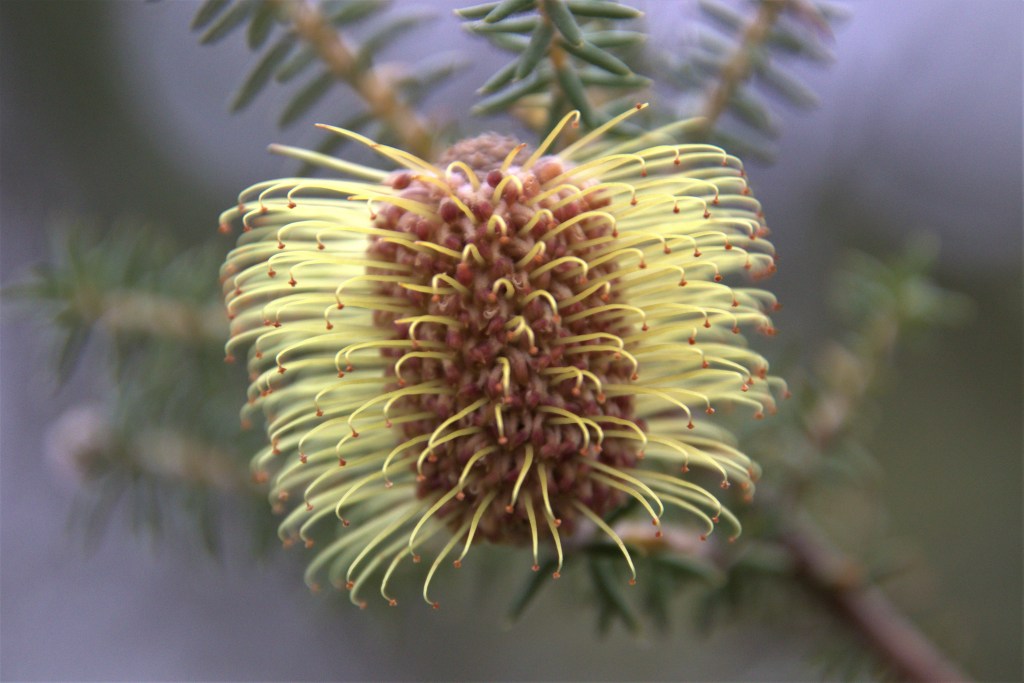
Banksia praemorsa – The Cut leaf Banksia
Flowering Period – Djilba and Kambarang
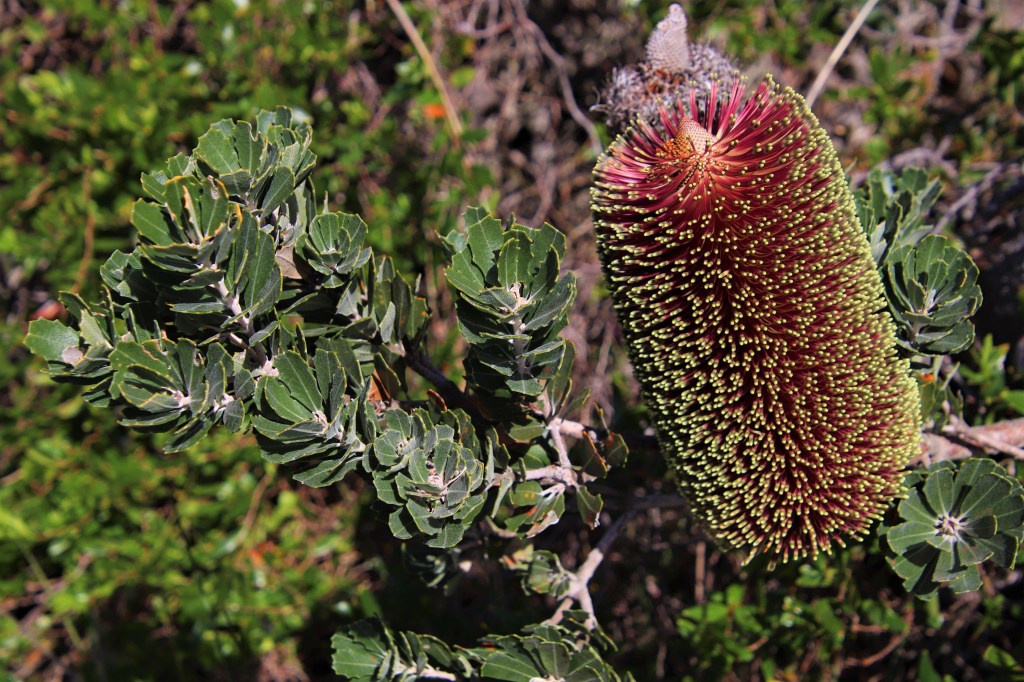
A species of the far South between Denmark and Cheynes Beach, it cannot be missed when walking the Bibbulmun Track on the approach to Albany, where it presents as a prominent bush on the coastal heathlands. The maroons, greens, yellows and pinks of the large flowers are a sight to behold.
A walk on the tough Mermaid Point 4WD Track, that passes through coastal heath behind Cheynes Beach is another location where this Banksia abounds. The truncated leaves of the species are most attractive and beautifully unique.
Banksia praemorsa.
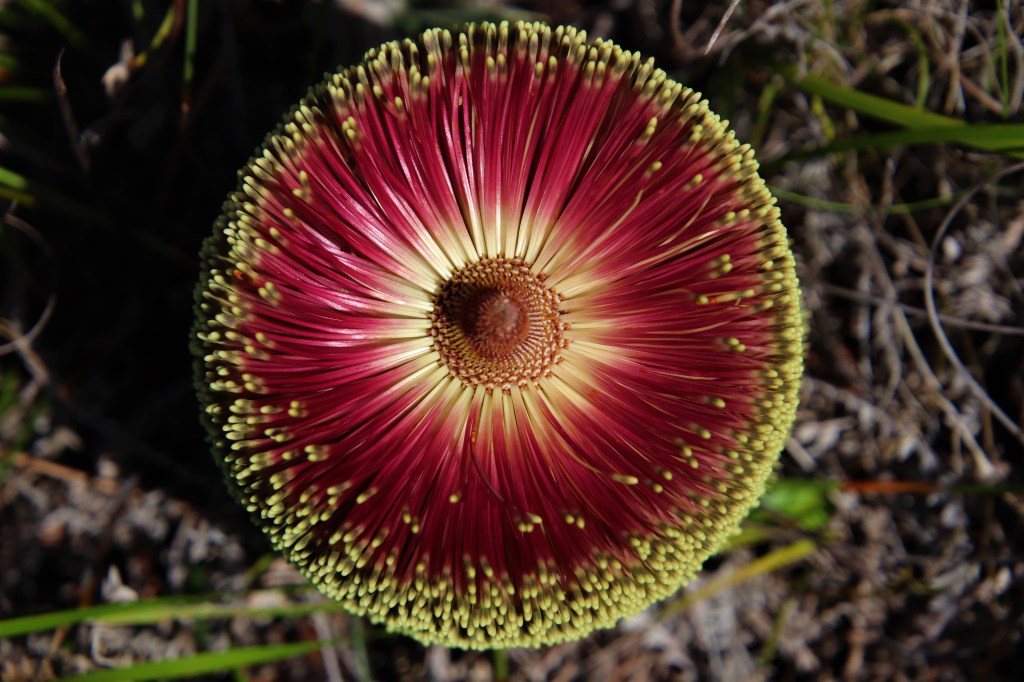
The trunacted leaves of Banksia praemorsa.
Guest Plant
Tassel Plant – Leucopogon verticillatus
Flowering Period :- Djilba, Kambarang
An iconic plant of Australia’s Southwestern Corner is the largest of Australia’s leucopogon species the Tassel Plant.
It is found throughout the wetter Karri, Tingle and Jarrah-Marri forests of the Southwest. The light-green leaves with prominent veins form whorls around the stalk forming intricate patterns when viewed from above. Surprisingly for such a splendid plant the pink and white flowers are surprisingly small.

Banksia solandri – The Stirling Range Banksia
Flowering Period – Kambarang
The Stirling Range is a national park stretching 65kms from East to West in Western Australia’s Great Southern Region. It is famous for both mountain walks and a fabulous array of wildflowers including some endemic Banksias.
Banksia solandri is named after the rather portly Daniel Solander, erstwhile colleague of that most famous of naturalists Joseph Banks after whom the Banksia genus is named.
It flowers in Spring in common with much of the flora of the Stirling Range. The flowers are quite woolly and the handsome, ornamental, oak-like leaves are, along with those of the Bull Banksia, the nicest of all the Western Australian Banksias.
Exploration around the lookouts on Stirling Range Drive have revealed this species, as has the tough climb of Talyuberlup Peak.
Banksia solandri.

Banksia grandis – The Bull Banksia
Flowering Period – Kambarang and Birak
The Bull Banksia is a true colossus among the Banksias, the flowering cones can reach a length of 40cm and contain upto six thousand flowers per spike. The giant deeply-lobed leaves are unmistakable. If there was a Banksia King this species would be it……….Grandis indeed!
It is found throughout the entire Southwest from the coastal heathlands where it occurs as a more stunted form, through to the stately trees of the Jarrah Forests that can attain a height of 10m.
Within the Jarrah Forest it is most often found on the lateritic soils associated with ridges.
The flowering cones are so large that that Brushtail and Ringtail Possums are regularly seen enjoying the nectar in the Jarrah Forest of Tone-Perup Nature Reserve.
See this post for a beautiful dark morph Brushtail Possum feeding on a giant Bull Banksia flowering cone :- Marsupial Magic at Perup.
Banksia grandis.

Banksia cuneata – The Matchstick Banksia
Flowering Period – Djilba, Kambarang into Birak
A Banksia that is a casualty of man’s destruction in Western Australia’s vast Wheatbelt is the fabulous Matchstick Banksia. No need for an explanation of the origin of the vernacular name.
Sadly it is also one of the Banksias most vunerable to dieback diesease and as a result of both these factors it would almost certainly be extinct in the wild without the dedication of envionmentalists.
I won’t in this case mention the location of the wild Banksia photographed, because of it’s rarity, but the Stirling Range Retreat do have cultivated plants on their grounds.
Banksia cuneata.
Banksia sphaerocarpa subsp sphaerocarpa – The Fox Banksia
Flowering Period – Birak – Bunuru – Djeran – Makuru
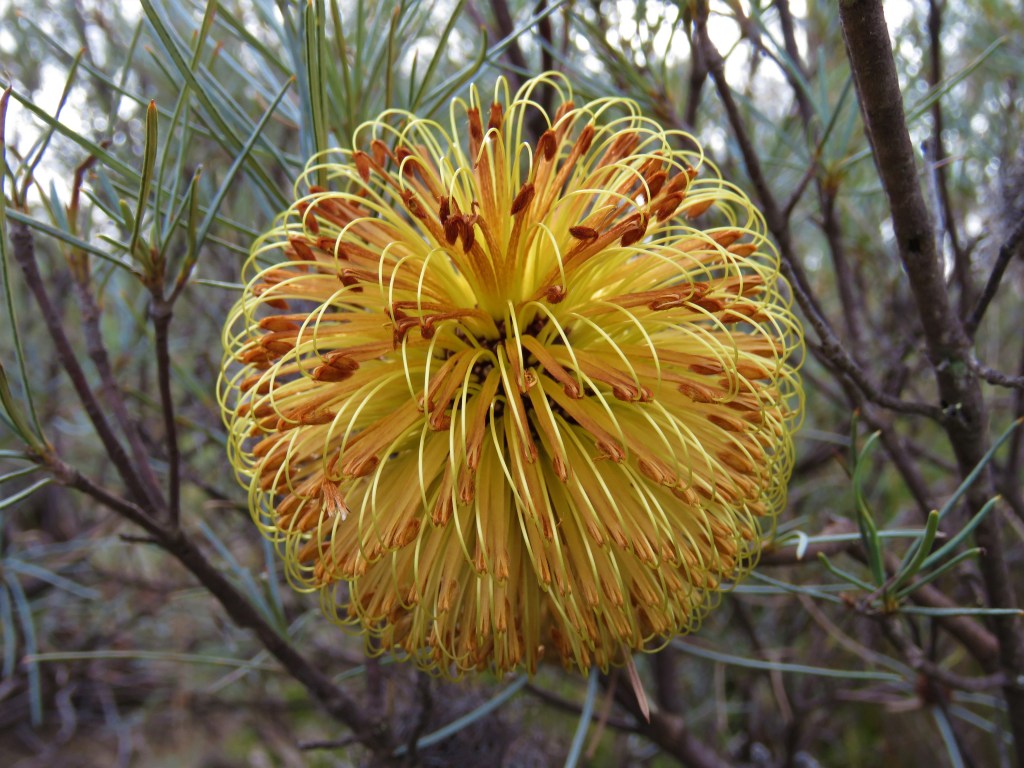
There are five subspecies of the sphaerocarpa Banksia, whose distributions range from Eneabba on the Northern Sandplains to East of Hyden in the Great Southern, and everywhere in between. It has been included in the Southwest for its locations in the Southern Darling Range, but also at the fabulous reserves of Dryandra, Boyagin and Tutanning where it flowers through all of Birak, Bunuru, Djeran and Makuru.
It is a keystone species in the Wheatbelt Reserves at what is otherwise a lean time of year, providing an important source of nectar at this time. It is a medium-sized shrub to 1.5m occurring on sandy loam over laterite which is the major geological feature of much of the area. The yellow and brown flowers are quite demure, but nonetheless extraordinary. Tutanning Nature Reserve has extensive areas of heath where this species is frequent.
Banksia sphaerocarpa subsp sphaerocarpa
Other Banksias that can be found in the cool Southwest Corner of the state are aculeata, menziesii, littoralis, gardneri, brownii, oreophila, coccinea, illicifolia, repens, attenuata, and goodii, some of which are covered in upcoming posts.
Continued in Part 3 :- Banksias of the Wild South Coast
#QuollingAround
 Quolling Around
Wow, Jimmy more Banskia info, how amazing you are! ✅Well done! This will definitely be something I will print to keep as reference. Banksias in our area are mostly Grandis and Seminuda. Thanks for all this precious info!
Izzy💚
LikeLike
We are definitely lucky with the Southwest Banksias, seminuda and grandis are fabulous!
LikeLike
Terrific posts Jimmy and a great idea to celebrate the WA Banksias as they (like so much else in WA) are stunning. As always, your fieldwork and research combine to make these posts perfect resources. Thank you. I’ve seen 3 of these and B.solandri was the most stunning whilst struggling up Talyuberlup. It’s so unique you immediately know its a Banksia you haven’t seen anywhere else!
LikeLike
Thanks Adam. Solandri is an absolute gem amongst Banksias. Worth the blood, sweat and tears ascending Talyuberlup!
LikeLike
great read Jimmy. I can see why you are fascinated with Banksias.
LikeLike
Thanks Tamara, such beautiful plants!
LikeLike
Wonderful! Thanks for sharing.
LikeLiked by 1 person
Just discovered your excellent blog. What a great resource! Banksias are a favourite of mine. Thanks for sharing such great shots and information. I look forward to exploring your archives.
LikeLike
Thank you for your kind comments Jane. Yes the Banksias are an absolute gem among many in Australian flora. I hope the information in the blog is useful to you. Enjoy the archives!
LikeLiked by 1 person