
Nyaki-Nyaki, Kalaamaya Country
It is early 2021 and Australia in common with the global community, was in the middle of the coronavirus pandemic, with the West Australian state border closed to the outside world. Disappointed like many with cancelled travel plans, I elected to use the pandemic period constructively.
On bush trips I continually encounter those most Australian of plants the Banksias. Banksias are a plant genus almost entirely endemic to Australia.
There are 79 species (and counting,) of which an impressive 61 species are found in Southwestern Australia. The various species flower year round with the nectar, and insects attracted to that nectar, an important source of nutrition for native wildlife.
There is an excellent Book titled Banksias (second edition) written by Kevin Collins, Kathy Collins and Alex George that acts as a fantastic guide for Banksia enthusiasts.
What began as a small local project to view some local Banksias, ultimately grew to span almost four years and the length and breadth of the Southwest.
In this the first part, the destination is the low rainfall areas of the inland Southwest of the continent, which is the domain of the arid-adapted Banksia species. These hardy Banksias found over a large area, share their habitat with some excellent reptiles.
Banksia elderiana – The Swordfish Banksia
Banksia elderiana was the first species I searched specifically for in mid-February 2021 as part of a greater trip to Fitzgerald River National Park.
The route taken to the South Coast was via the Wheatbelt, where tough Banksia elderiana occurs from the Eastern Wheatbelt into the Great Western Woodlands.
Banksia elderiana flowers from Jan to March and was in peak flowering at the time of the trip. The Banksia photographed was in remnant bushland on the Lake-King Norseman Rd, just outside the township of Lake King.
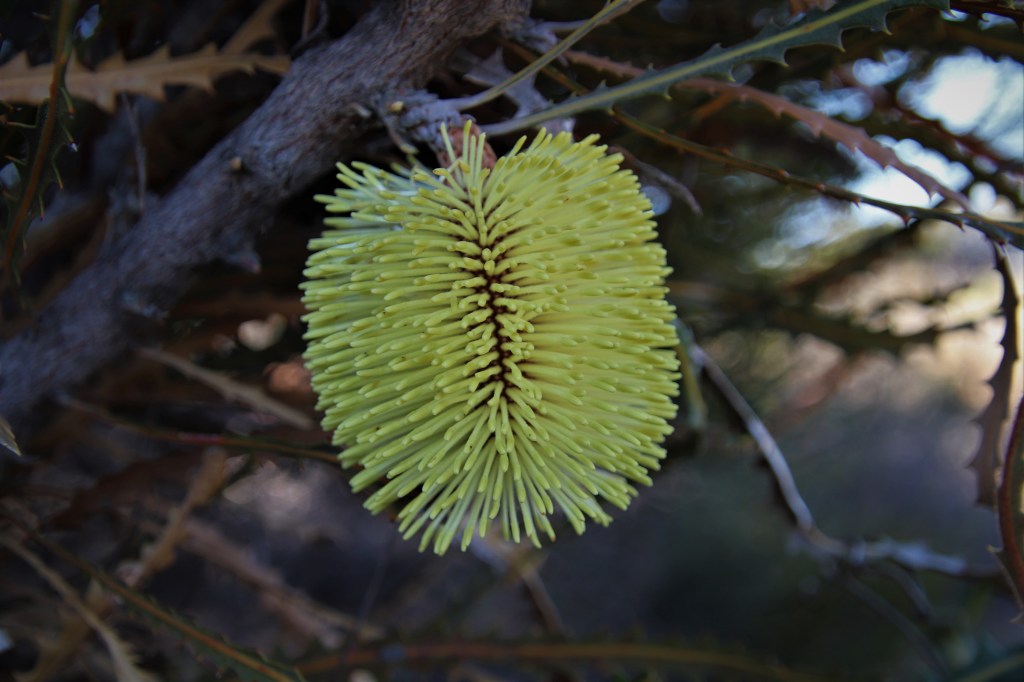
The genesis of the common name Swordfish Banksia is attributed to the long thin leaves. While the beautiful yellow flowers are pendulous and are concealed mostly within the foliage.
Banksia elderiana.
Banksia audax – The Bold One
Another species of the Eastern Wheatbelt and North into Borabbin National Park is the beautiful two-toned Banksia audax. This Banksia species can be found at all of Dragon Rocks Nature Reserve, Emu Fence Road and Borabbin National Park.
The flowering period of Banksia audax is Nov to Jan, and so a December drive 154km North along Emu Fence Rd between the town of Hyden and The Great Eastern Highway, would hopefully turn up this species.
Wildlife is plentiful on Emu Fence Road with all of Malleefowl, a Crested Bicycle Dragon, Bearded Dragon and Thorny Devil seen.
Thorny Devil (Gravid Female.)

A Western Bearded Dragon seen at the Northern end of Emu Fence Road was playing a game of chicken with the mining trucks as it basked on a stretch of tarmac.
Western Bearded Dragon.

Although not a prevalent plant along Emu Fence Road, Banksia audax is locally common in suitable areas of sandy heath habitat.
Due to the small size of the plant (under 1m) patches can be hard to locate while driving.
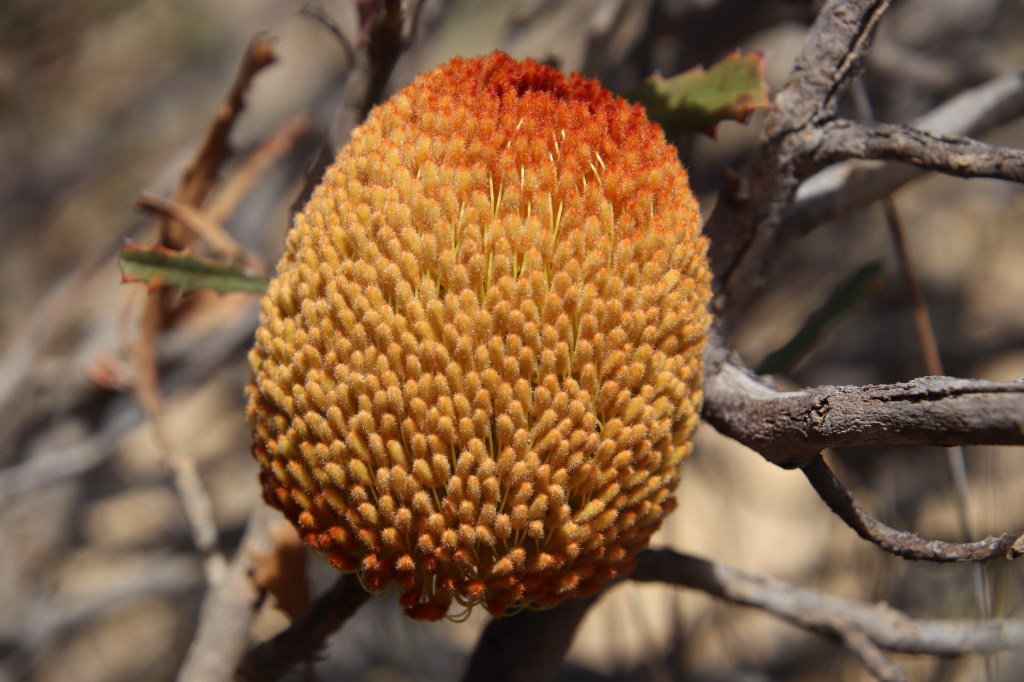
The flower spikes are also small but the colouration is spectacular. They are rusty orange colour at the extemities while the majority of the spike is an attractive creamy buff.
Banksia audax.
The return journey to Perth was along the Great Eastern Highway. As the afternoon wore on so cloud cover increased. The overcast conditions made for a worthwhile stop to photograph Silo Art outside the town of Merredin where the oppressive humidity was by now tangible.
Silo Art – Merredin.

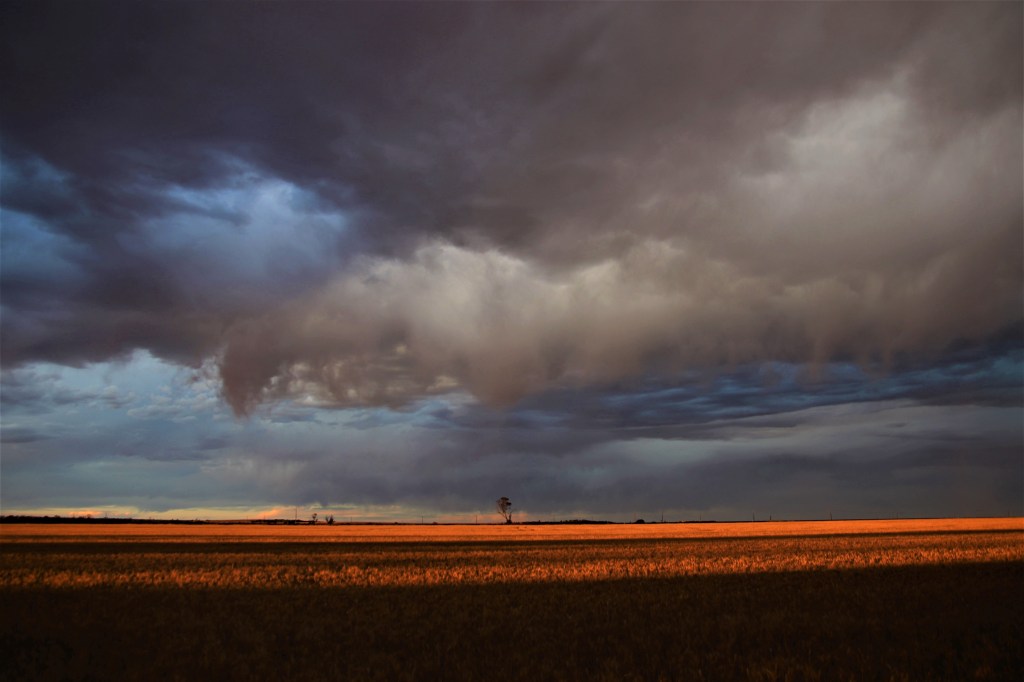
Leaving Merredin the weather got super interesting. The sky turned an eerie shade of yellow as fingers of water vapour reached earthwards to lick the scorched earth from the gigantic thunderheads building in the heavens above. Rumbles of thunder split the stratosphere and a stiff wind added to the exhilaration plucking plumes of dust from the sun-baked landscape.
Thunderstorms over the Wheatbelt.
The impending sunset saw the sky ablaze with a kaleidoscope of yellows, pinks, rich mauves and purples as the setting sun illuminated the underside of the moisture-laden thunderheads.
A Moody Sunset at the Wheatbins of Doodlakine.

Banksia laevigata ssp fuscolutea – The Tennis Ball Banksia
A later visit to Emu Fence Road in December was timed to coincide with the flowering of another semi-arid adapted Banksia. Banksia laevigata subsp fuscolutea, one of the two subspecies of Tennis Ball Banksia.
The latin name fuscolutea chronicles the two prominent colours, brown (fuscus) and yellow (luteus) of this subspecies. The roadside air was thick with the sickly sweet ambrosial scent of the flowers, which had attracted a throng of insect pollinators whose wingbeats strummed the hot, still air.
Banksia laevigata ssp fuscolutea.

Banksia Lullfitzii – A Rare Beauty!
Easter saw a return to inland WA to photograph the final semi-arid adapted Banksia of the area. Banksia lullfitzii is a rare species, only discovered by non-indigenous Australians in 1966.
The flowering period is from March to May and the distribution is patchy between Borabbin National Park and South through sandplain country to Ravensthorpe.
It took two long weekends of searching the vast fly-ridden sandplains of Borabbin National Park before this species was located, and only then after concentrating the search on a sandy area containing both Banksia audax and Banksia elderiana did the differing foliage of this species become apparent.
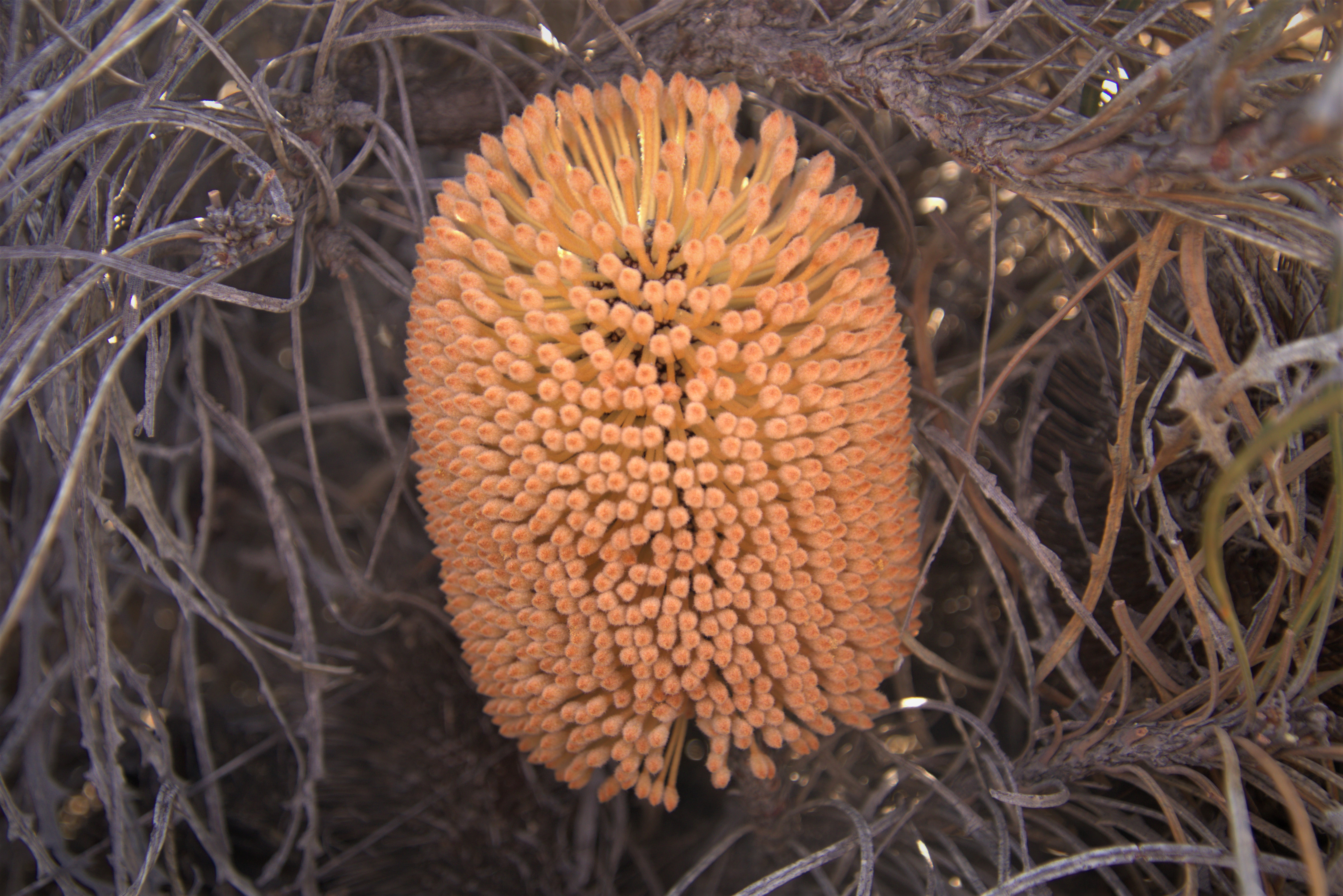
It isn’t helped that the flower spikes of Banksia lullfitzii are hidden within the foliage. Many of the plants contained no flower spikes, so when finally a rich golden-orange flower spike hidden in the depths of the dead foliage became apparent, it was a great moment after the long drive and search.
Banksia lullfitzii.

The arid-adapted Banksias require the most effort to find, but the rewards of finding these spectacular plants were more than worth the endeavour.
Continued in :- Banksias of the true Southwest – The Cool, Damp Corner.
#QuollingAround
 Quolling Around
oh wow Jimmy! My SIL would love this post so as she loves natives and does murals and wood burns native plants. I’m going to link it to her
hope you’ve been well!
LikeLike
Hey Christina, hope you SiL enjoys. I have planted lots of Banksias at Bridgetown. Hopefully I have some sucess with them! Hope all going well with the little ones
LikeLike
Love this Jimmy! 👏🏼Thankyou for sharing! I love Banksias!!💚Hows life going in Bridgetown?
Any chance you’ll be visiting Nannup sometime soon? You’d be welcome anytime! We love it here! 🥰Izzy & Daniel
😉
LikeLiked by 1 person