
Continued from:- Winter in Carnarvon – Part 1, Burrowing Bees and Burrowing Frogs.
Wooramel Riverside Retreat
Wooramel Riverside Retreat is located East of the Northwest Coastal Highway along a 3km unsealed but well signposted track, 124kms South of Carnarvon. I had previously passed this turnoff numerous times on long return journeys to the Ningaloo, Pilbara and Kimberley regions. Finally it was with delight, that I found myself with the time to stop and explore.
A lovely campground ranges along the Northern bank of the Wooramel River amongst a grove of gnarled Red River Gums, while an onsite cafe, The Upside Down Cafe, gives a nod to the subterranean river. The climax of the Riverside Retreat however, are four artesian baths brimming with warm bore water.
To relax in these hot tubs after dark as the cold desert air descends, while the night sky is bursting with stars, is an experience long remembered.
Official Website:- https://www.wooramel.com.au/
Wooramel Riverside Retreat.


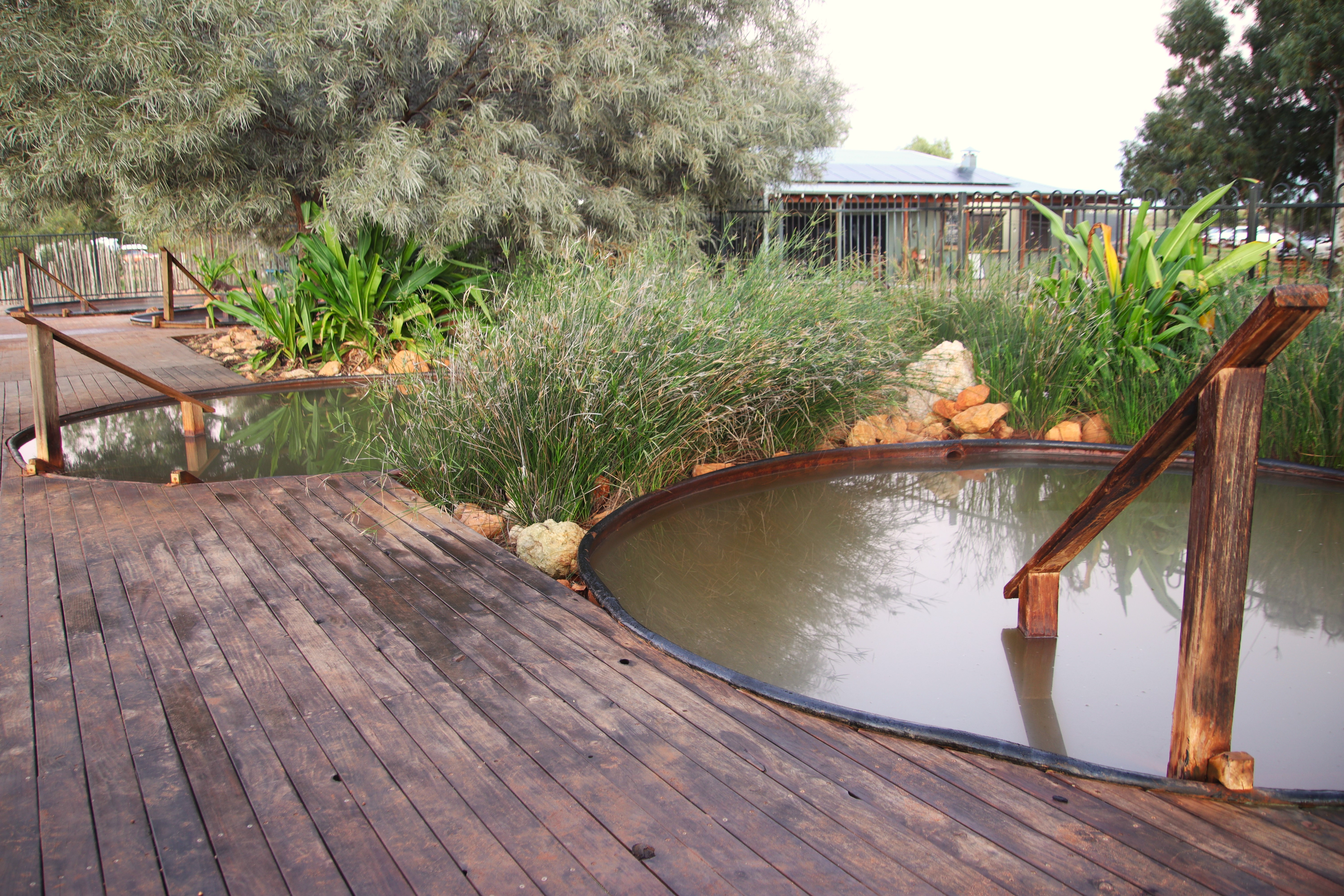
The relative proximity of Carnarvon to Wooramel presented the opportunity to visit thrice over four months. The first visit was in late Autumn, the second in mid-Winter and finally as temps began to warm, the last time in early Spring.
Late Autumn
Driving the unsealed road to the homestead, a cloud a red dust billowed out behind the 4WD, for Autumn temperatures were still blazing and the region hadn’t seen rain for many months. Once checked in, it’s a case of choose your own campsite, where a tent site costs $40 per night which includes unlimited access to the artesian hot tubs.
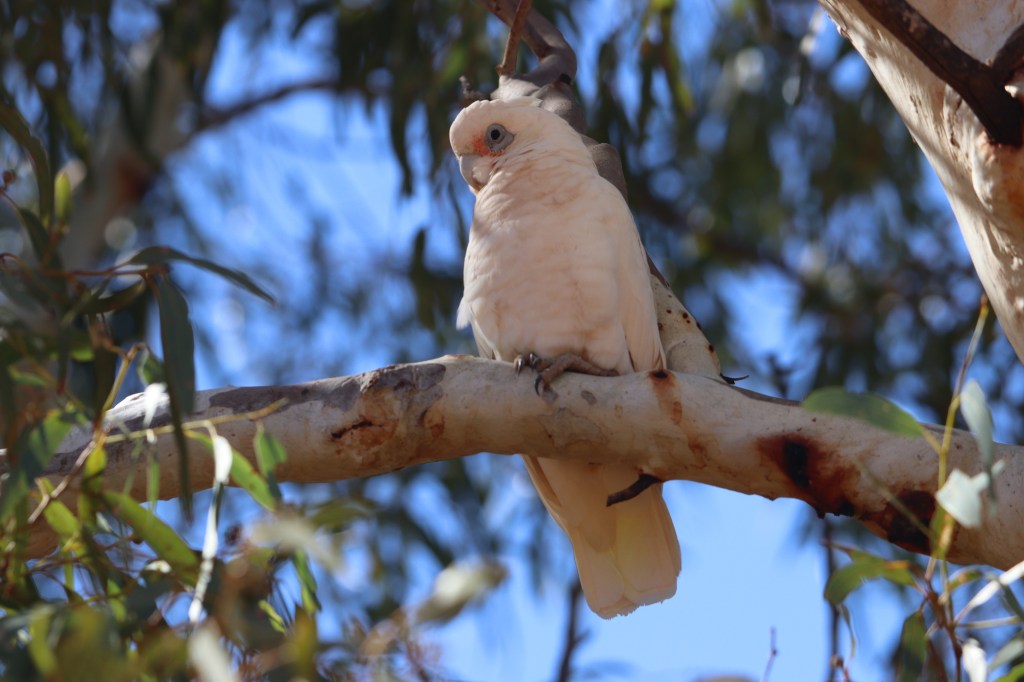
While setting up camp, a flock of Little Corellas self-soothed in the mighty Red River Gums (Eucalyptus camaldulensis) overhead, while the hot desert wind rustled the leaves.
Little Corella.
Late afternoon when the worst of the heat had diminished, I set off to walk the marked 5km trail that traces the banks of the Wooramel River. The flies were far too friendly, so it was fortunate I carried my fly net, an essential accessory when visiting Wooramel in the warmer months.
The first 2.5km of the trail travels East adhering to the Northern riverbank, before crossing the sandy riverbed and returning to camp on the South bank. Wildlife sightings increased on the return to camp with birdlife including Galahs, Willy Wagtails and Babblers.
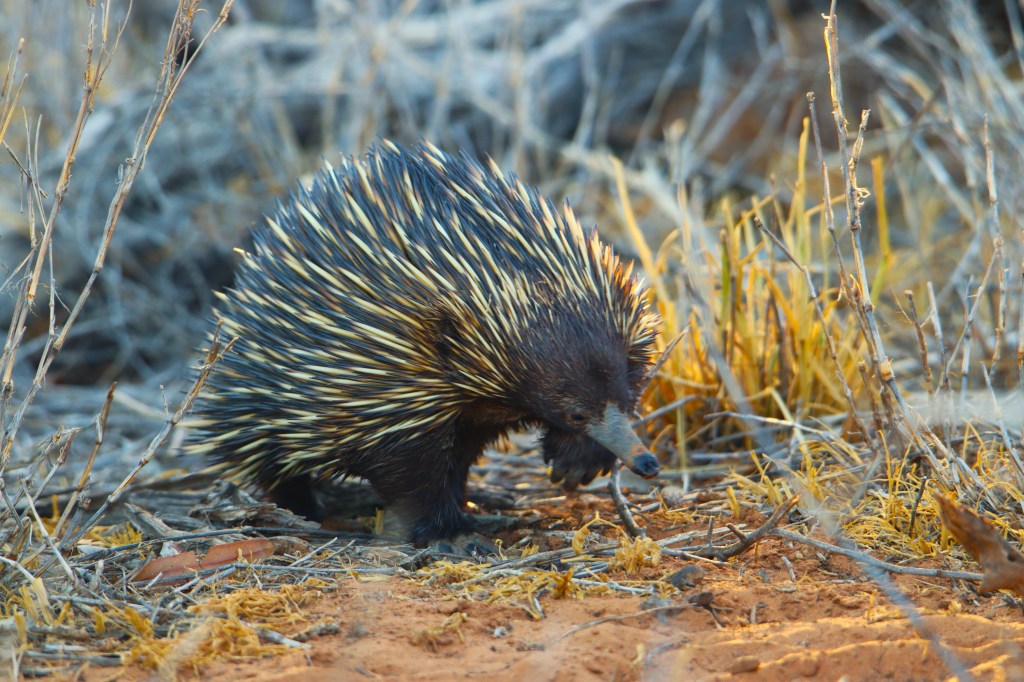
I delighted in finding a busy Echidna snuffling through the leaflitter for invertebrates, and sat quietly to observe and enjoy. Immediately after a second Echidna was encountered. Unusual for a solitary mammal with a large home range.
Echidnas mate during Winter, so it was a possibly a male attracted to the opposite sex for the chance to mate. Sometimes multiple males will follow a female to become what is known as an Echidna Train. I had previously witnessed this phenomenon at Dryandra Woodland (see below.)
Wildlife at Dryandra – Boyagin Nature Reserve – Tutanning – 2017-2018 – Part 2 – Spring into Summer
Echidna.
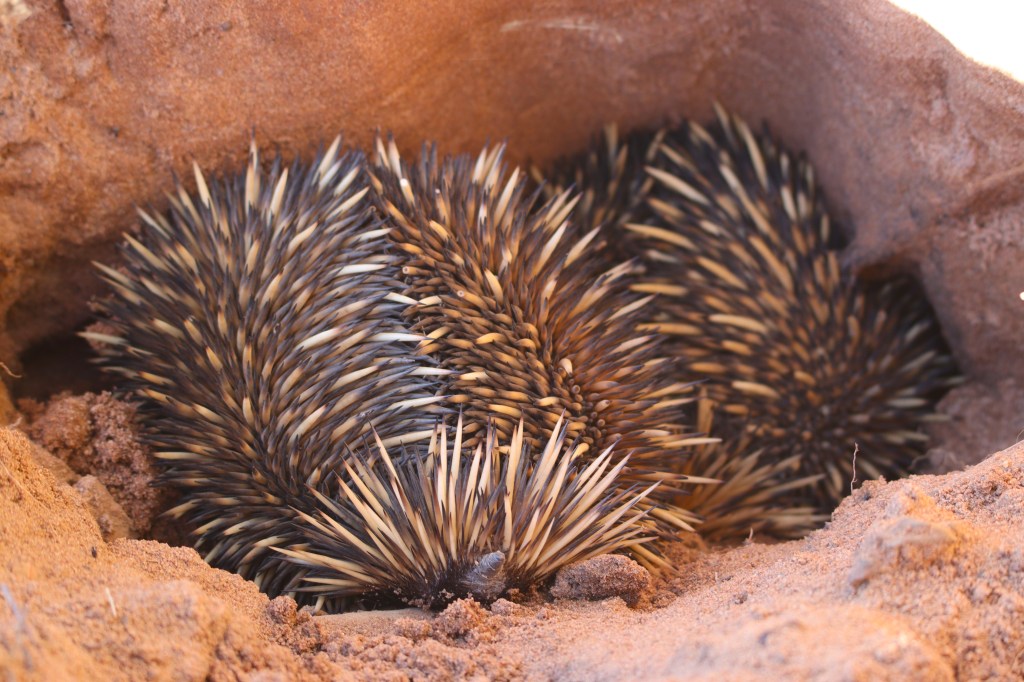
That second Echidna shuffled down the river bank to enter a sandy hole where there was a third Echidna. The Echidna Train theory was starting to gain substance.
Echidnas Everywhere!
I returned to the campground and after dinner lazed languidly in the artesian baths. It was incredible to lie back in the warm water and marvel at the spectacle of the Australian night sky teeming with a billion stars. In a nearby Corkwood the rythmic clicking of a Cicada filled the balmy evening. It was utterly perfect.
The mystery of the Echidna gathering was solved while spotlighting the Riverside Walk. At the location I had seen the numerous Echidnas, a Euro (Wallaroo) was busy digging the sandy hole….
The powerful claws of the Wallaroo were able to efficiently dig through the sandy bed of the dry river, to the water running below the surface. Did the Echidnas also help to excavate the hole? A sort of multi-species effort to access the precious resource. How the Echidnas knew of this water access point at this precise location in the vastness of the land was an absolute mystery.
A fourth and final Echidna for the day was added to the tally on the return to the campground. This animal was given away by the tremendous noise it made bulldozing through the leaflitter under the cover of dark. The Wooramel River it seems is an Echidna hotspot.
Back at the campground turning in for the night, the wind strengthened. What began as short sharp gusts quickly became a howling gale, threatening to rip the guy ropes from the ground.
Even worse was the fine, wind-whipped red sand blown into the tent by the wind. In a short time my sleeping bag and pillow were covered, so that each time I moved there was an audible crunch. Then came the rain, lashings and lashings of torrential rain. The first cold front of Winter had smashed into the Gascoyne.
The following morning the weather had calmed, so after removing sand from my nostrils and earholes I set off for an early morning walk, leaving the tent fly open to air. I hadn’t walked a kilometre before a heavy shower forced shelter until a gigantic bough of a Red River Gum.
Hunched in a ball as the persistent rain poured down, it wasn’t long before large droplets dripped down the neck of my T-shirt. Despite the discomfort it occurred to me that I was seeing a usually semi-arid landscape during a rare rain event. In that moment my perspective changed for the better.
During a break in the showers I returned to my tent to find the flysheet I had left open had let in the rain, which had in turn transformed the red sand inside into a red sludge. I considered myself beaten. It has been a lovely introduction to Wooramel but it was time to return to Carnarvon….
Mid Winter
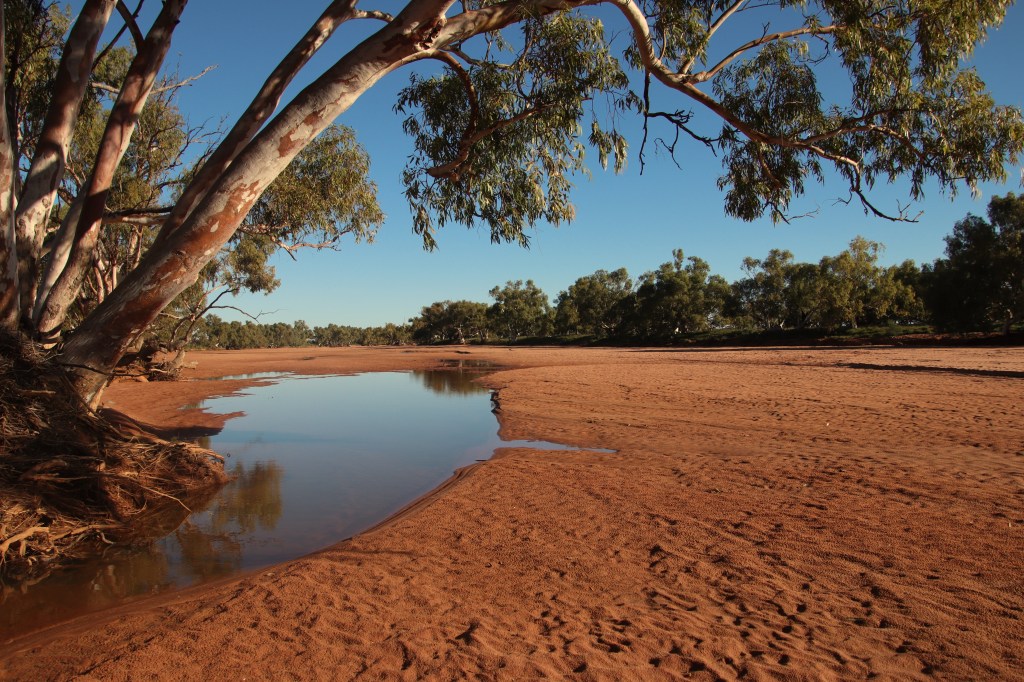
The second visit to Wooramel during the month of July, was after considerable Winter rains had fallen. The Wooramel River had recently been running above ground, but at the time of my visit ephemeral pools in the sandy riverbed were all that remained.
An Ephemeral Pool in the Wooramel Riverbed.
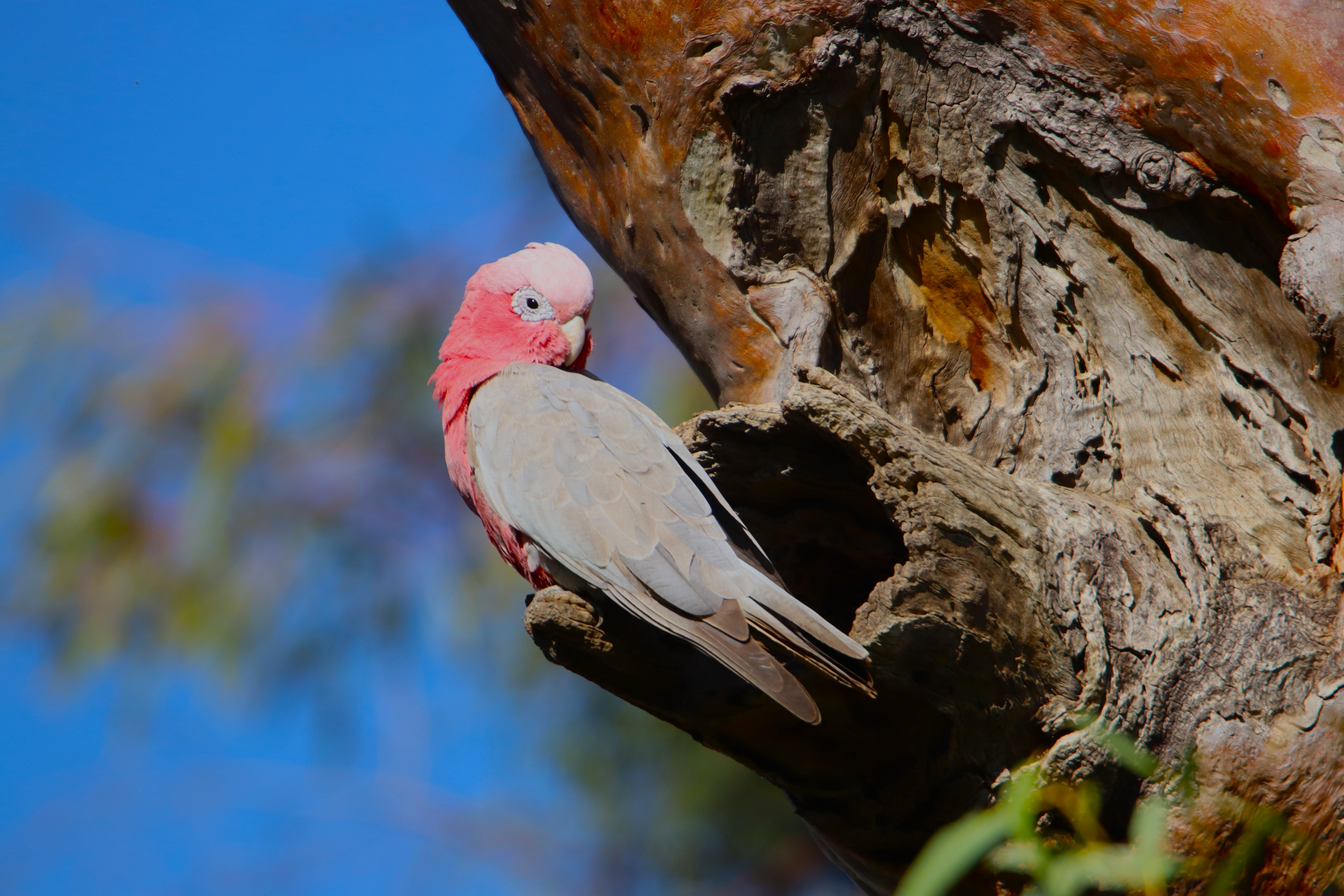
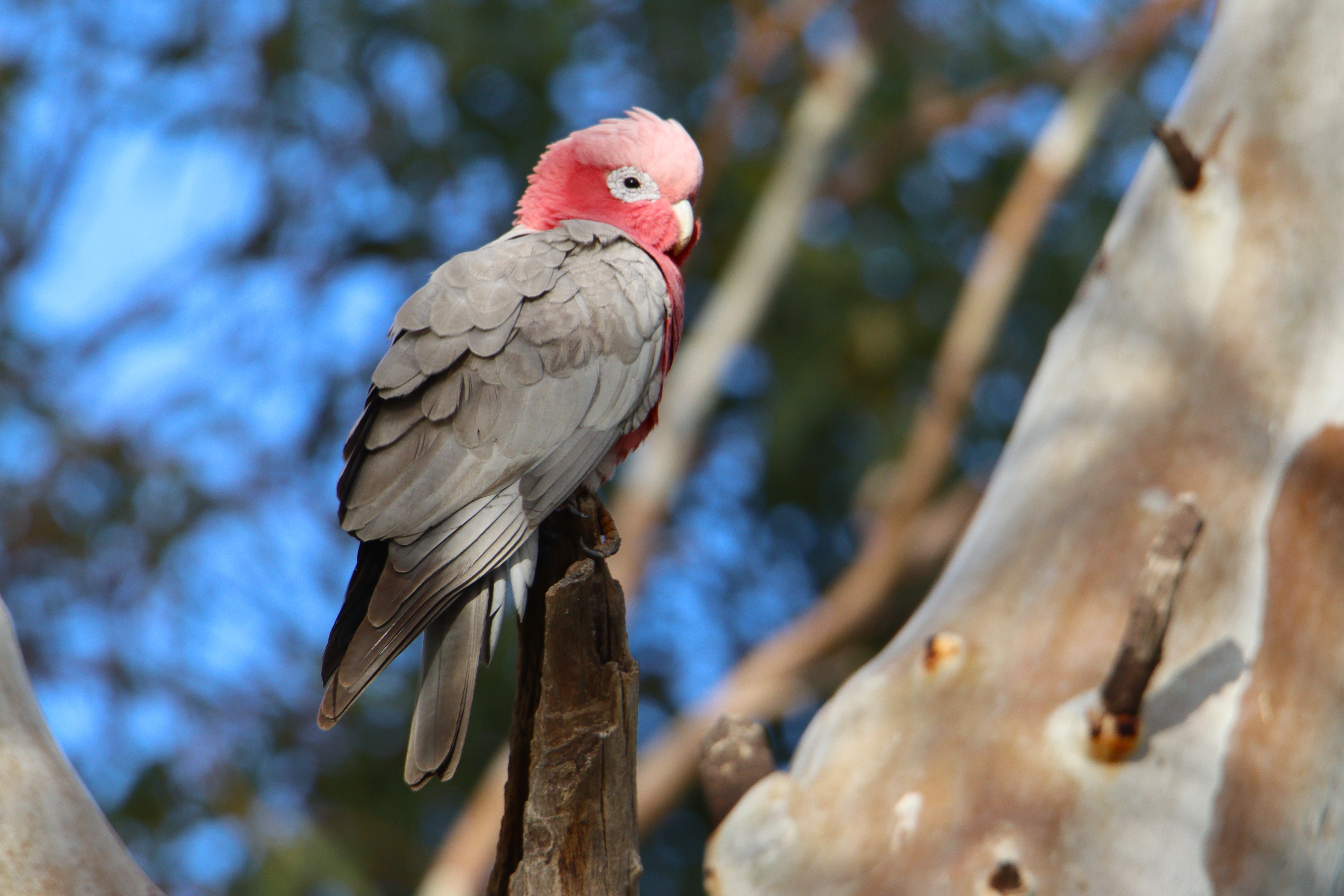
July in mulga country is peak nesting time for Galah’s, and hollows in the ancient Red River Gums created by long-fallen branches are prime real estate. It seemed as though every hollow was being investigated by a noisy pair of Galahs, which in common with many of Australia’s parrots mate for life.
Galah’s Real Estate Shopping.

Early Spring
The third and final visit to Wooramel coincided with the final weekend in the Northwest, and so I splashed out $125 to stay in an onsite Outcamp 3 Man Tent at Wooramel.
Outcamp 3 Man Tent at Wooramel Station.

During a dawn Riverside Walk, a small flock of Cockatiels were disturbed from the ground where they were feeding on grass seed, up into the safely of the trees. The first time I had seen this, the smallest member of the Cockatoo family up close.
These desert nomads are mostly found in mulga habitat, especially along watercourses where they nest in Red River Gum hollows. The vernacular name of Weiro is provided by the contact call when small flocks of these birds are in fast flight across the vast interior.
Cockatiel.

I left Wooramel Sunday mid-morning with a view to exploring station tracks on the return to Carnarvon. The weather had warmed but the day was tending overcast, nonetheless I hoped it would be a good chance for some of the local reptiles before my imminent departure.
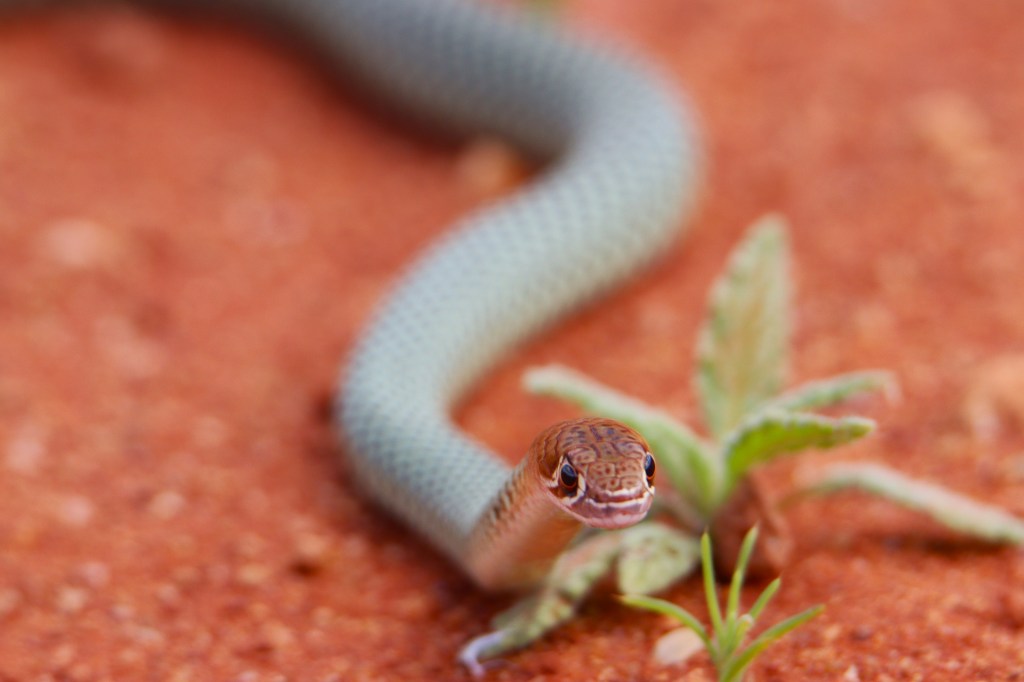
After leaving the highway the first reptile encountered was a small swift-moving snake, I leapt from the car for a closer look. White lines on the eyes and lip were quite remarkable. I suspected a Whipsnake from the size and agility, which was later confirmed after consulting a text. It was in fact a Yellow-faced Whipsnake, the most widely distributed of Australia’s Whipsnakes.
Yellow-faced Whipsnake.
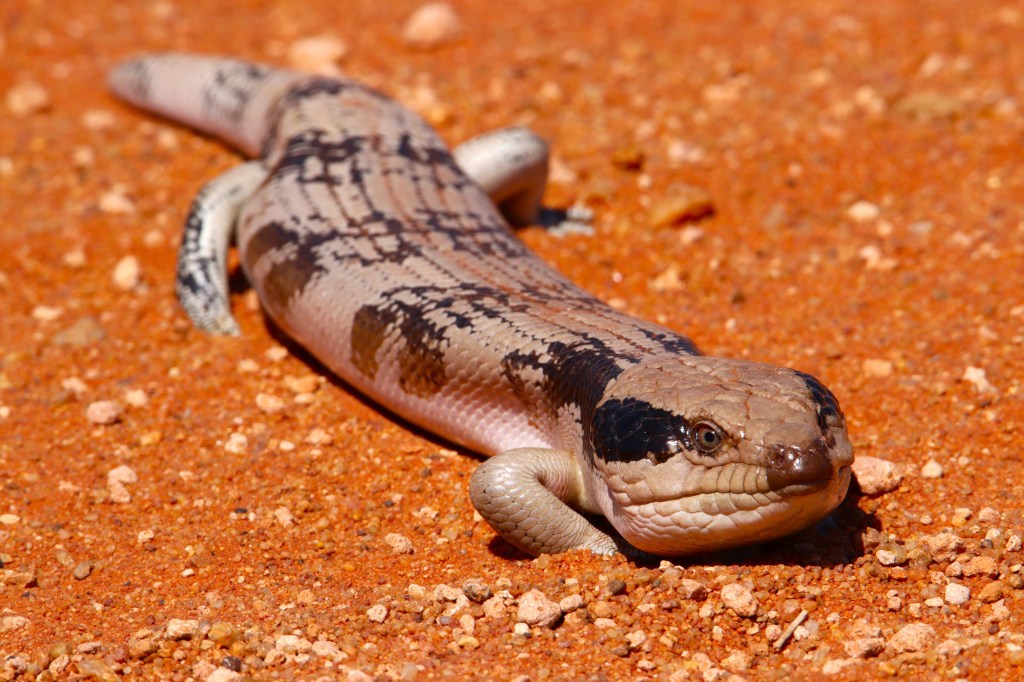
The station tracks of the Gascoyne quickly become a maze as I travelled on under an endless sky. A Bluetongue lizard splayed flat on the warm, sandy track to optimize heat absorption was reluctant to move.
This Western Bluetongue Lizard is almost at the limit of it’s distribution in the Gascoyne, until further North it is replaced by the Centralian Bluetongue Lizard.
Western Bluetongue.
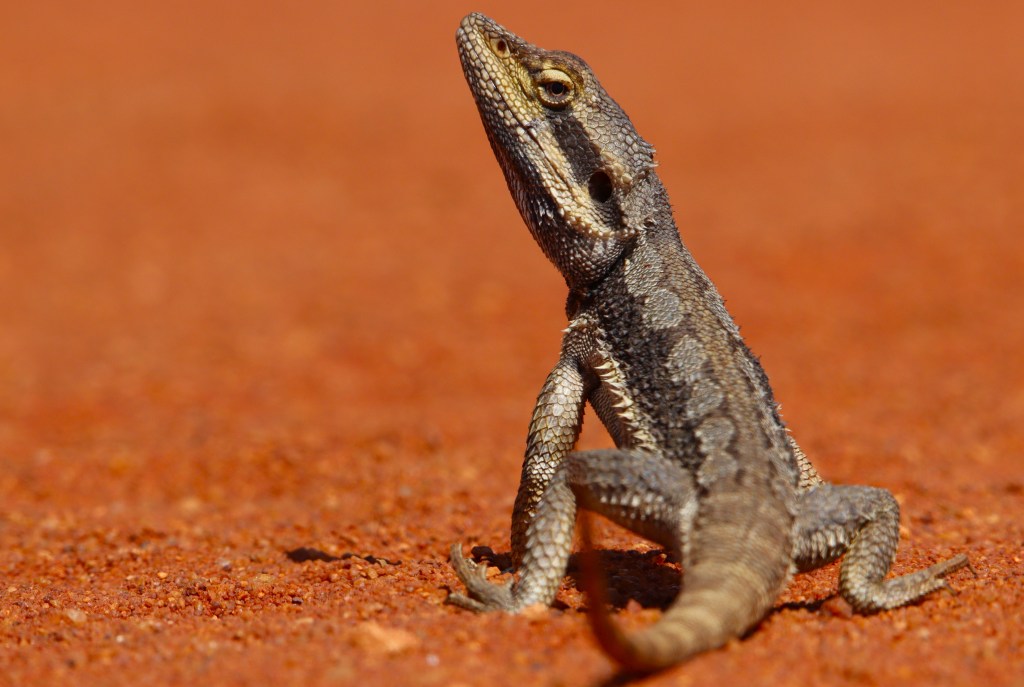
Within a kilometre I came across a second species of reptile, although this lizard was very much alert. The Western Bearded Dragon is also known as the Dwarf Bearded Dragon on account of the diminutive size when compared to the Bearded Dragon of the Eastern States. It is most often encountered basking on roads and tracks, but can also be found on logs and branches.
Dwarf (Western) Bearded Dragon.
A little further along the track the reptile action exploded. There were Netted Ground Dragons and Lozenge marked Bicycle Dragons everywhere. It was remarkable.
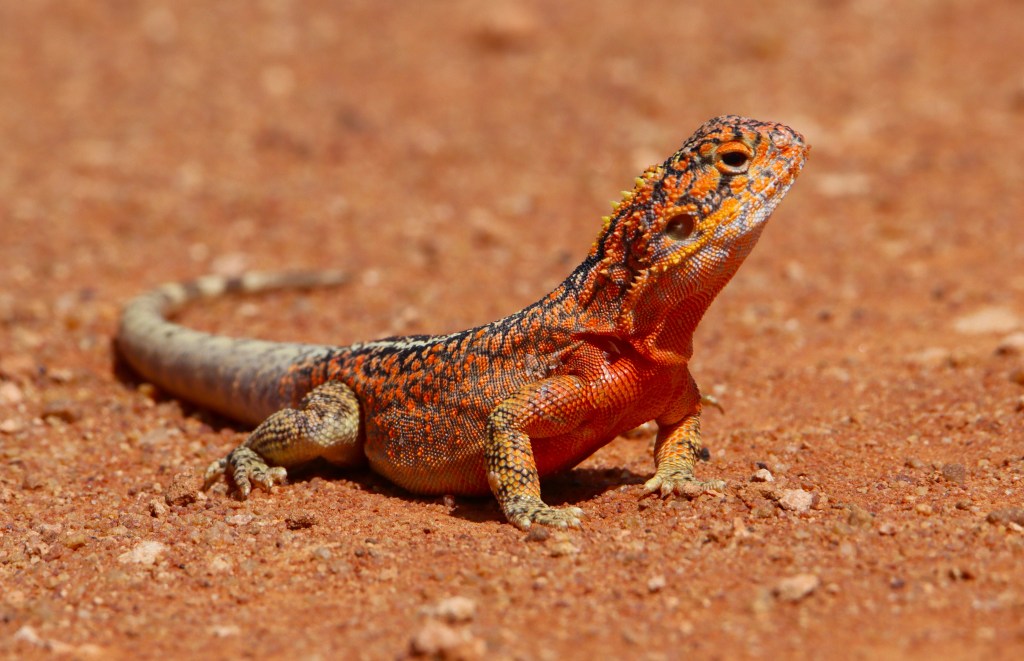
The Central Netted Ground Dragon (Ctenophorus nuchalis) below is a breeding male flushed bright with orange. These, and the very similar Western Netted Ground Dragon (Ctenophorus reticulatus,) resemble mini-bulldozers with their blunt heads and stocky build.
The two species are most easily distinguished by tips of claws which are pale in Ctenophorus nuchalis and dark in reticulatus. These lizards are not particularly fast and so often bask near a burrow entrance, from whence they can dash into when feeling threatened.
Central Netted Ground Dragon.
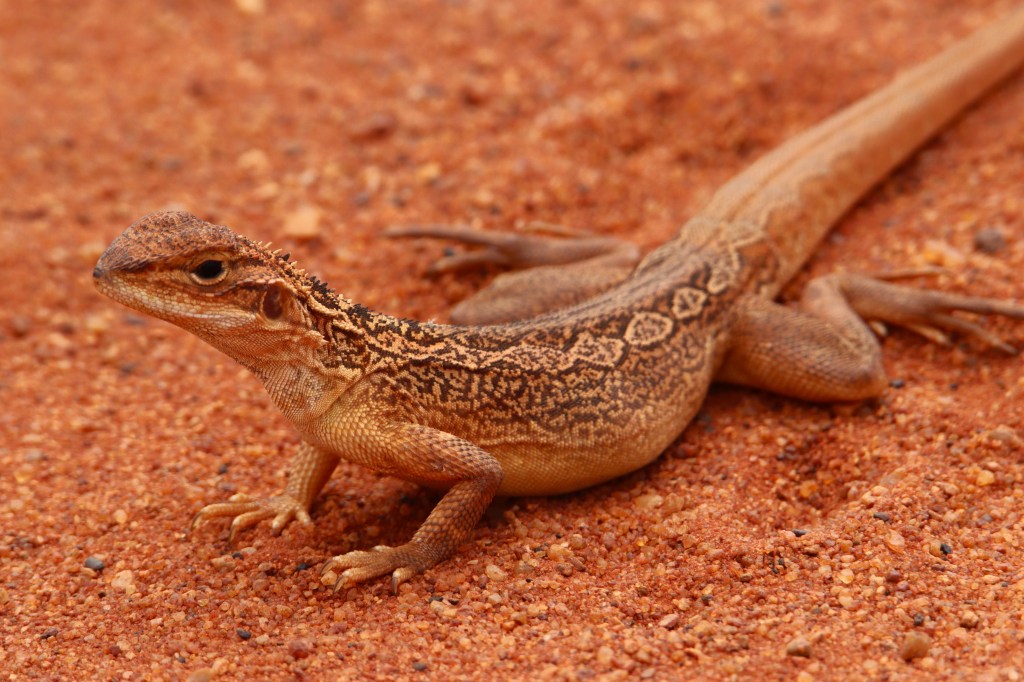
In contrast the Lozenge marked Bicycle Dragons are made for speed, aided by generous hind limbs and feet. Indeed, they are known as Bicycle Dragons because of the upright bipedal locomotion used at speed. The length of the tail in this species exceeds the body (S-V) length.
Lozenge marked Bicycle Dragon
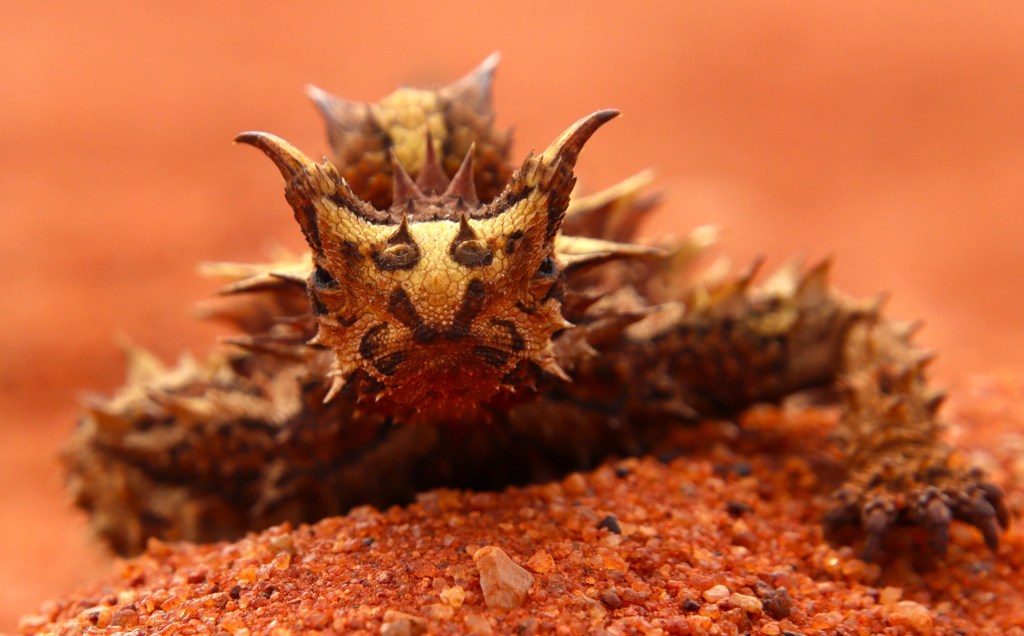
It had been a truly exceptional morning for herps but approaching the tarmac once again the day reached new heights when hugging a tyre track in the sand for warmth was a Thorny Devil.
Thorny Devil.
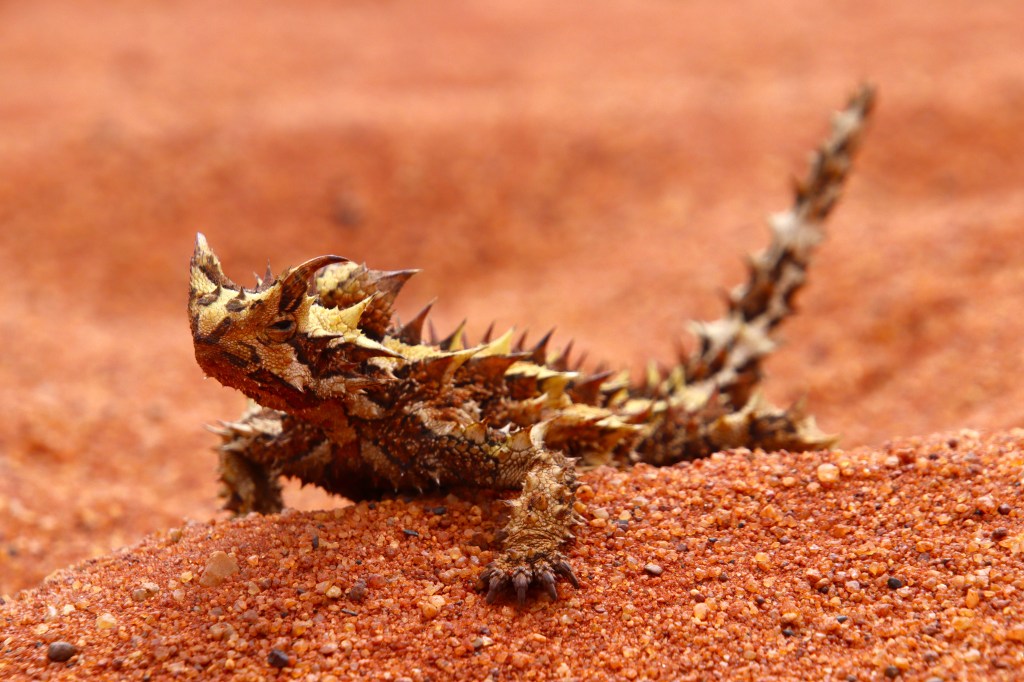
The unique scalation and intricate patterning of this species is next level, even more so up close. Fearsome they may look but a more placid reptile I have yet to meet.
Thorny Devil.
Mundatharrda (Kennedy Range National Park.)
Carnarvon is the nearest town to the Kennedy Range National Park, and yet it still requires a journey of half a day. The first section is along the sealed Carnarvon-Mullewa Road to the small settlement of Gascoyne Junction, after which the road is unsealed for the final part, although fine for 2WD in most conditions.
It is on the approach to Gascoyne Junction that the first views of this 75km by 24km colossus are glimpsed. Even from this distance it is evident this is one impressive geological feature, known as Mundatharrda in the local Ingarrda language
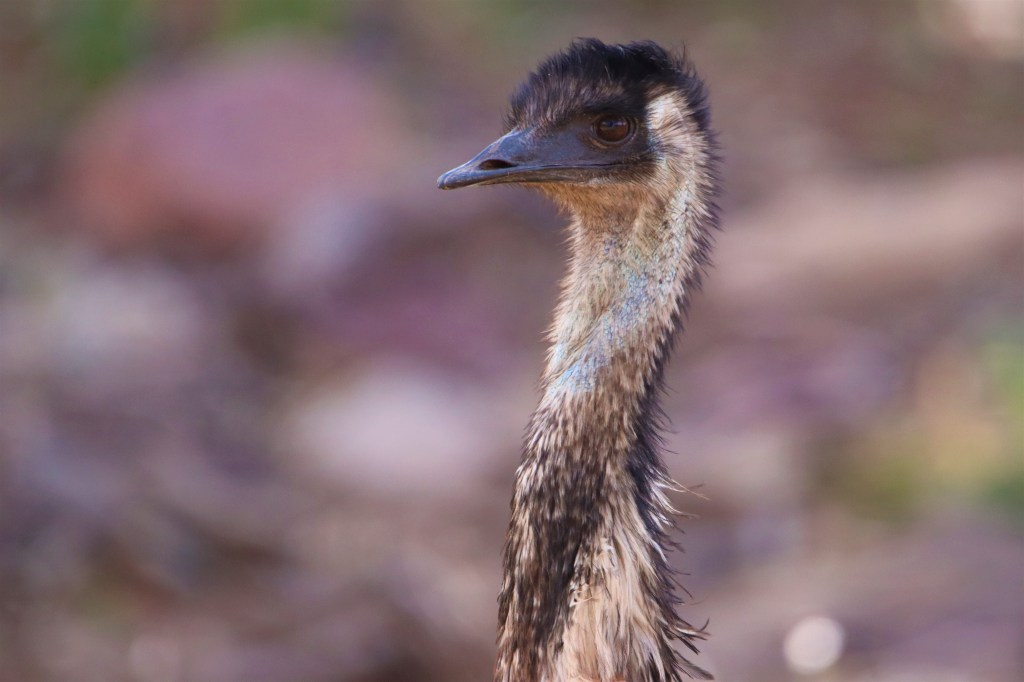
As the wide dusty track travelled along the Lyons River Floodplain North of Gascoyne Junction, Emu’s were the first wildlife seen, while to the West the imposing Eastern cliffs of Mundatharrda rise dramatically 100m above the floodplain.
Emu on the Lyons River Floodplain.
The rust red cliffs continue to reach higher into the vast blue sky on the 12km access road into the park, until finally the campground nestled into the base of the cliffs near Temple Gorge is reached.
Mundatharrda’s Outstanding Eastern Escarpment.

The basic campground has drop-toilets, a communal fire pit with campground hosts during the Winter months. Water and firewood are not available in the park and must be brought in. A tent site costs a respectable $11, and on arrival I set up amongst a lovely she-oak grove.
There was perhaps only an hour or two of light remaining, enough time to explore part of the escarpment base trail. Euros were reasonable common along the tail given away by clattering rocks as they scrambled up the scree to the safety of higher ground.
As darkness cloaked the desert, I ate dinner under a moonless sky. The cosmic chandelier in the heavens above was stupendous. Looking up in awe I was inspired to attempt astrophotography before I left the Gascoyne.
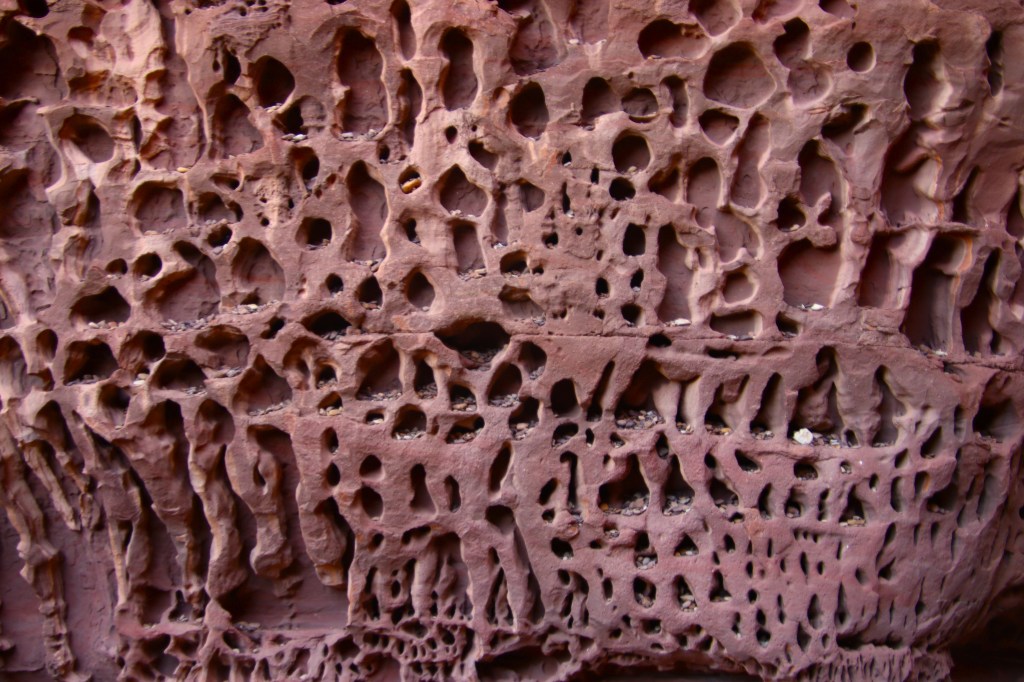
The following morning prior to dawn I visited the sunrise viewing platform before calling in at nearby Honeycomb Gorge. This is perhaps the most famous of Mundatharrda’s Gorges where at a terminal amphitheatre a honeycomb wall sits next to a dry waterfall.
Honeycomb Wall at Honeycomb Gorge.
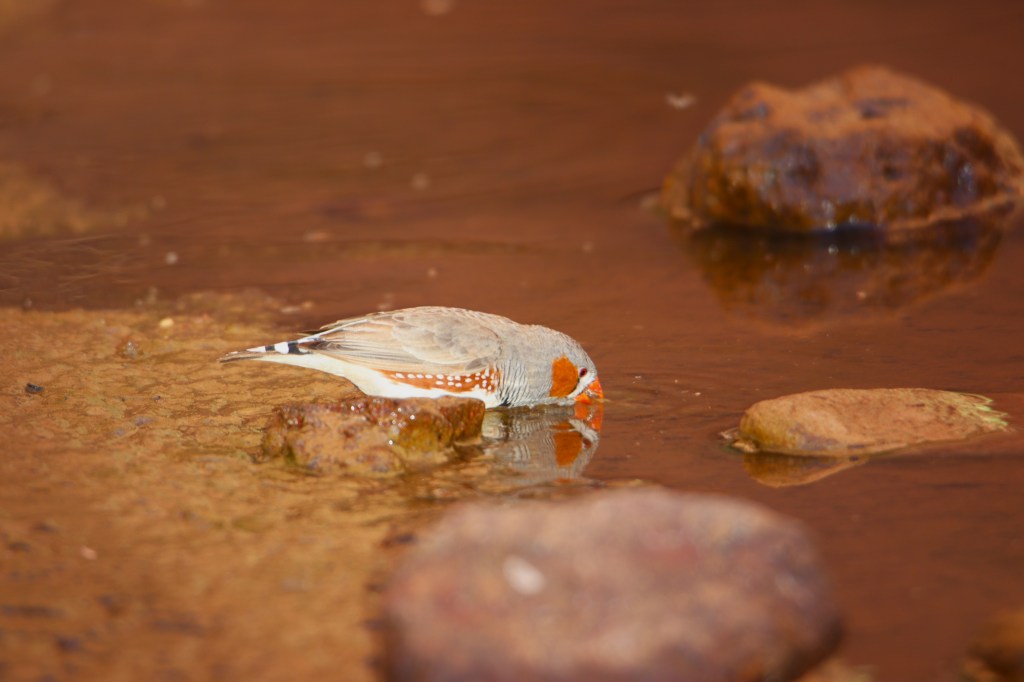
Recent rains had left a small ephemeral pool at the base of the waterfall, and as I sat quietly the gentle beeps of a small flock of Zebra Finches could be heard encroaching from the surrounding bushes. After confirming the absence of danger they came into drink from the small pool, ever cautious.
Zebra Finch drinking early morning at Honeycomb Gorge.
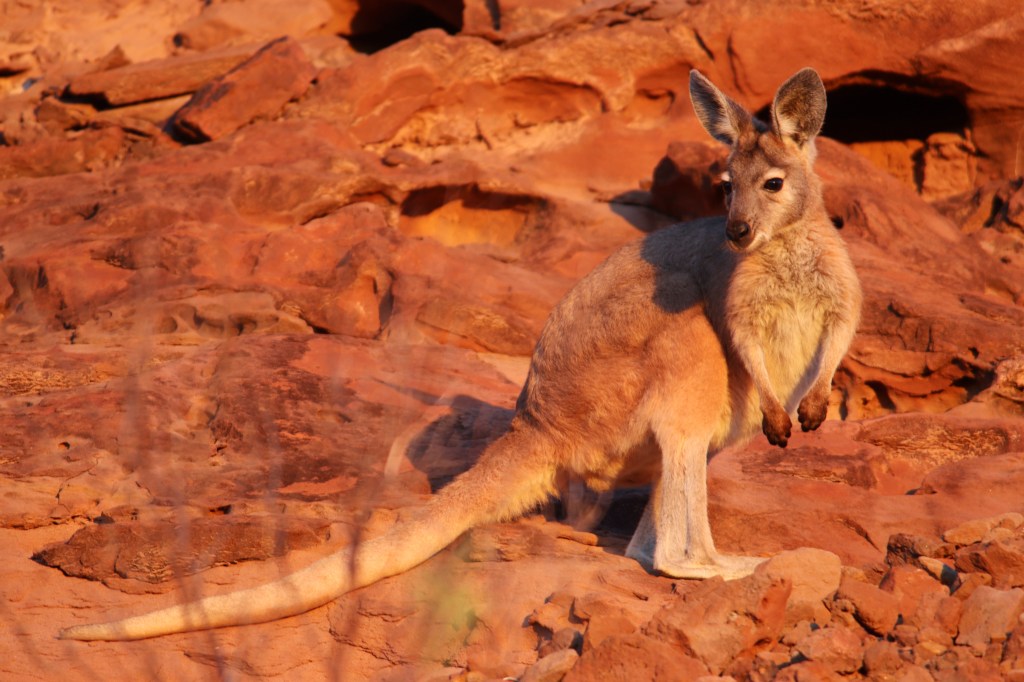
I returned to the campground but before breakfast explored the scree slope of the bluff above the campground finding a mother and Euro joey. The colour of the red rocks of the range were ebullient at this early hour.
Euro – Escarpment Trail.
Over the course of the day I walked both Drapers and Temple Gorge. Both these enjoyable trails are a mere 2km return but require some rock hopping. Both run East West so with the Winter sun in the North of the sky there was always shade to be found.
The Temple for which Temple Gorge is named.

The Escarpment Trail climbs from the Escarpment Base Trail South of the campground, up onto the summit of the plateau with commanding and neverending views over the distant Lyons River Valley Floodplain below . A must do if visiting Mundatharrda and fitness allows.
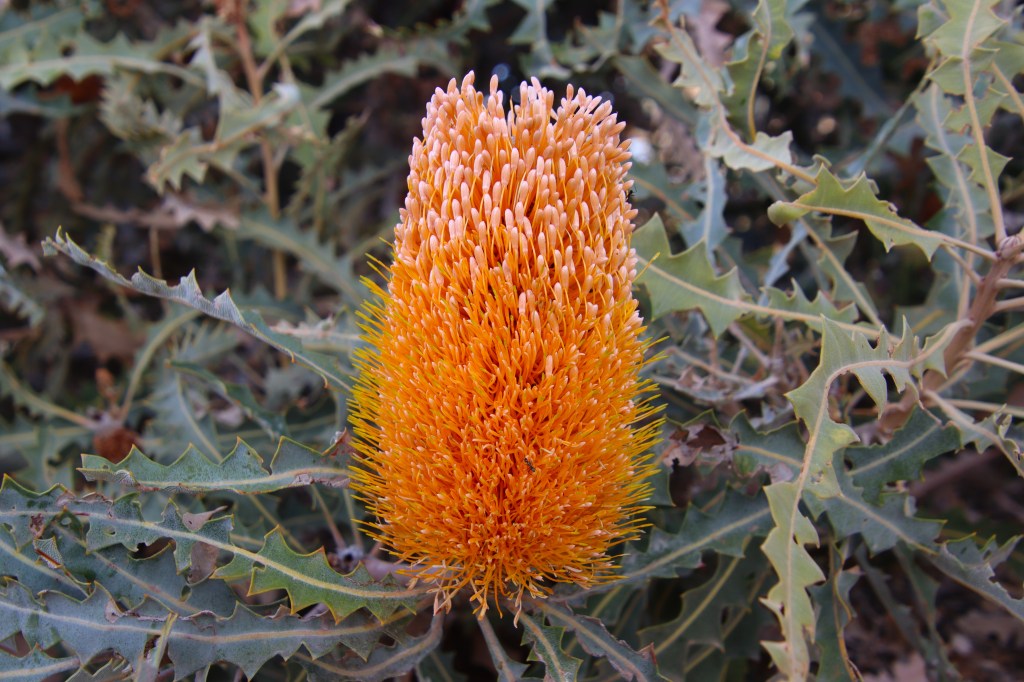
A detour was made to a line of red iron-rich sand dunes to the West. I had read of an outlier population of Banksia ashbyi subsp boreoscaia occurring at Mundatharrda and knew the preferred habitat was deep red sand. Indeed the dunes were rich in Banksia bushes although the flowering season clearly had only just begun with a single flower occurring at this time.
Banksia ashbyi subsp boreoscaia.
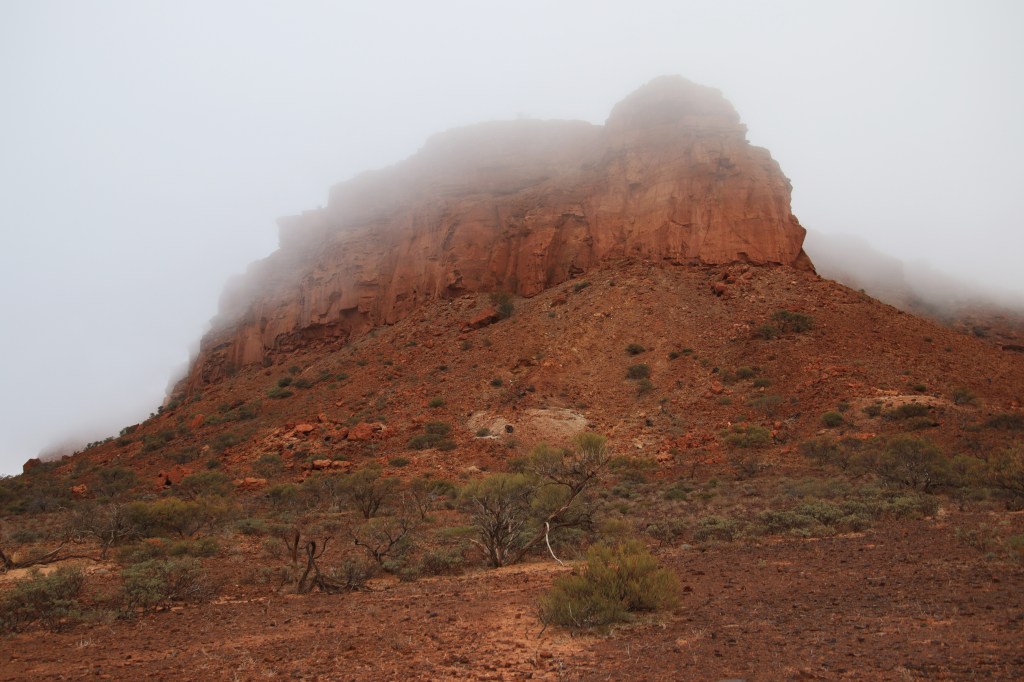
After the sun had set, cloud drifted across the desert skies ahead of a cold front to obscure the magnificent show in the heavens above. Compensation came the following morning in the form of Mundatharrda draped in a blanket of low cloud and mist, muffling the usual sound of the desert dawn chorus. A rare occurrence and one I was lucky to behold.
Misty Morning at Mundatharrda.
Both Wooramel and Mundatharrda (Kennedy Range) are worthy of a visit if travelling through the Gascoyne. I didn’t make it to Buringurrah (Mount Augustus,) on this trip. That is on the wish list for another time.
The final part of this series – Winter in Carnarvon – Part 3, Quobba Station to Exmouth – will visit destinations North of Carnarvon, from impressive Red Bluff to Cape Range National Parlkat the tip of the Northwestern Cape.
#QuollingAround
 Quolling Around
Hello Jimmy,
Thank you again for sharing your adventures. I could visualise the billions of stars and feel the gritty sand and uncomfortable heavy raindrops. Particularly loved reading about your reptile encounters, especially the magical Thorny Devil and spectacular Central Netted Ground Dragon. What a find!
LikeLike